
A full email address usually has two parts:
“Display Name” <email address>
The display name is optional. Sometimes you will only see the email address, such as Alfred@gmail.com.
The sender can type almost anything as the display name. It is usually meant to be a name people can read easily, such as “Alfred C.” But it is not checked against the real email address, so the display name can be misleading.
Scammers
Scammers often use a display name that looks familiar, such as “Mr. Smith” or “The Rev. Grey.” But the real email address belongs to the scammer, not to the person the display name indicates. If you reply, your message goes to the scammer.
Many email programs show only the display name in your inbox, not the actual email address where the email comes from. Here is an example from Gmail on the web:

So how can you find the real email address? It depends on which email program you use.
In Gmail on the web, move your pointer over the display name to see the sender’s real email address.
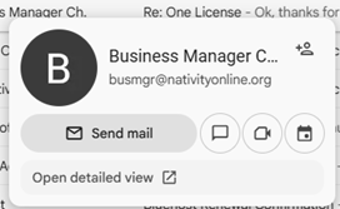
In this example, the real email address is busmgr@nativityonline.org, which is a legitimate address.
If you want even more details about the sender, click the “Open detailed view” link.
In Microsoft Outlook, open the message to see the sender’s real email address.
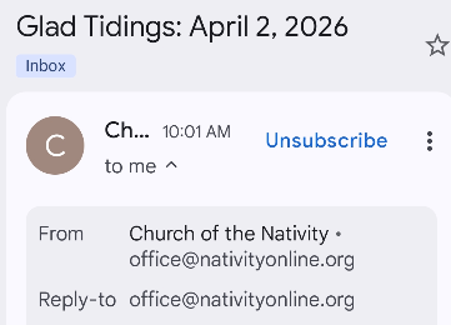
In the Gmail app on Android or iPhone, open the message and tap the down arrow below the display name to see the sender’s real email address – in this case, office@nativityonline.org.
The following is a real example of the kind of email some of you may have received.
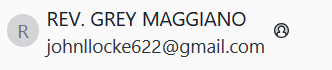
As you can see, the display name says, “REV. GREY MAGGIANO,” but the real email address (johnllocke622@gmail.com) has nothing to do with Rev. Grey:
An email like this is spam – do not reply to it but report it as a scam and delete it right away.
Conclusion
If an email seems to be from a Nativity staff member or volunteer, check the full email address. If it is not a real someone@nativityonline.org address, it is probably a scam. Report it to our office coordinator.
This advice applies to any suspicious email, not just messages that appear to come from Nativity. For example, an email may look like it came from a bank or mortgage company, but the real sender address may be a random email account.
When in doubt, check the sender’s real email address.